Visualizzazioni post:92

There are bands that change to follow trends, and there are those that change simply because they know no other way to make music. For more than thirty-five years, Sigh have undoubtedly belonged to the latter category. Emerging from the extreme black metal scene of the early Nineties, the Japanese band led by Mirai Kawashima have built a discography that defies any single definition, weaving together jazz, classical music, psychedelia, progressive rock and Japanese tradition without ever losing their identity.
With their new album Goh-Ka, inspired by the Buddhist paintings known as Kusōzu and the theme of impermanence, Sigh add another chapter to an artistic journey that continues to defy categorization. And yet, talking to Mirai reveals a vision surprisingly different from the one often attributed to the Japanese outfit: no pursuit of avant-garde ideas at all costs, no desire to shock simply for the sake of it, but merely the ambition to make, each time, an album better than the one before it.
We spoke with him about the meaning behind Goh-Ka, the relationship between chaos and control in the songwriting process, his collaborations with Mikael Åkerfeldt, Frédéric Leclercq and Mike Heller, black metal as a language that remains open to experimentation, and what it means to keep creating music today after more than three decades, having never stopped following his instincts alone.
 The first Sigh albums were rooted much more in black metal, while later records became increasingly experimental. Looking back after more than thirty-five years, do you feel this evolution happened naturally, or was it a conscious decision to avoid repeating yourself?
Mirai: Well, whenever I make an album, I always want to make something that tops the past works. It’s a bit different from avoiding repeating ourselves. If I think I can make a better album
with the same direction from the previous one, I’ll go for it. So probably it’s best to say it was something between a conscious decision and a natural progression.
When I first discovered Sigh through "Imaginary Sonicscape", what struck me was how impossible it was to categorize the music. Did you already know while writing that album that it would become such an important milestone in your career?
Mirai: Actually even when the album came out, the reactions were a mixed bag. Some people loved it while others vehemently hated it. So I never thought it’d be our milestone album even after the album was released. I really am not sure when it started to be considered as one of our best albums honestly.
You’ve always mixed black metal with jazz, classical music, psychedelia and traditional Japanese influences. Has there ever been an idea that even you thought was “too crazy” for a Sigh album?
Mirai: I threw away a lot of songs and ideas. The only thing I rely on is my ears. Whenever I come up with a new idea, I just make a demo and keep listening to it to see if it flows well. If not, I just
throw it away. So it does not have to be “too crazy” to be abandoned, but the ideas that didn’t flow well were not used.
Do you think today’s metal audience is more open-minded than it was in the 90s, or do you still encounter resistance from listeners who expect Sigh to fit into a specific genre?
Mirai: Oh yes, they are way more open-minded now. When I started Sigh in the early 90s, some idiots would come to me and say “You should’t use keyboards in extreme metal!” as an advice.
Many musicians describe songwriting as solving a puzzle. Your music sounds more like building a labyrinth. How do you know when a song is actually finished?
Mirai: Again, it’s all up to my ears. I listen to my own works so many times. It’s pretty easy for me to tell if a songs requires more, or sometimes some parts should be cut. Of course it’s not a universal right answer, but at least it is right to me. For Goh-ka, at first I was planning to write a 30-min epic long song, but when the song reached 10 min, it was obvious to me that the song was
done. If I had added more, it would have just ruin the song. That’s why, I wrote 4 songs based on Kuso-shi instead of one 30-min long song.
Goh-Ka explores Buddhist themes and the Kusōzu paintings depicting the decomposition of the human body. What fascinated you most about this subject? The philosophical meaning, the visual
imagery, or something else?
Mirai: This is the essence of Buddhism, namely nothing lasts forever. It shows the sheer fact that even the most beautiful person will uglily rot away in the end and this tells you that you should
not stick to your life too much as it will go away sooner or later. As a Japanese person, I can relate to it very much althought I am afraid of death so much.
 Despite dealing with death and impermanence, Goh-Ka never feels depressing. Was it important for you to approach these themes with curiosity rather than despair?
Mirai: I am not sure how the album sounds to listners, but personally I think it’s based on despair than curiosity.
You’ve collaborated with many outstanding musicians over the years. What was it about Mikael Åkerfeldt’s musical personality that made him the perfect choice for “Unputenpu”?
Mirai: When I was thinking about the solo on Unputenpu, I happened to hear from Mikael, and I quickly thought it’d be a good idea to ask him for participation. So it happened pretty much
naturally. He was kind enough to say yes, and definitely nailed it. His solo was something I exactly wanted for the song.
Frédéric Leclercq and Mike Heller come from very different musical backgrounds. When you invite musicians like them into the studio, are you looking primarily for technical excellence, or for a different musical perspective?
Mirai: Definitely both. Our previous guitarist could play fast, but he wasn’t a musician at all. His fingers move fast and that was it. So just having technical excellence isn’t good enough. Both Fred
and Mike have technical excellence and at the same time they are great musicians. And as they perfectly understand what I want, it is very easy to work with them. They also give their own ideas
to boost the musical quality.
Sigh have never really followed trends, yet many modern metal bands seem to have embraced ideas you've been exploring for decades. Do you ever feel you’ve been ahead of your time?
Mirai: I’ve never thought about that. But I feel that we have the best following right now during our more than 35-year activity. I am not sure if that means we were ahead of time though.
 I’ve read in previous interviews that you don’t consider Sigh an avant-garde band, but rather a fairly conservative one. You’ve often cited bands like Venom and Celtic Frost among your main influences. What is it that makes you see Sigh as a conservative band, and why do you think so many listeners perceive your music as something innovative and very different from traditional
metal?
Mirai: In metal, what we are doing may be different, but if you look at rock music in general, it is nothing new. Many of our ideas come from the late 60s rock music, which is 50 years ago! They already took in Sitar, classical, free jazz, and everything. How can a band inspired by 50-year-old ideas be avant-garde? Even for Goh-ka, the main inspiration comes from classic metal bands such
as Celtic Frost, Voivod and Black Sabbath.
After more than thirty-five years, what still excites you about making a Sigh album? What keeps the creative fire alive?
Mirai: There are 3 elements. The first one is that a confidence that I can make an album that tops the past works. If not, I don’t see any point in making a new one. Then the second is that we have
fans that are waiting for a new album. Even if I have a confidence about the musical quality, I have no will to make it if no one wanted to hear it. The last is that we have a decent label back up. I am
too lazy to release an album ourselves. Luckily Peaceville has been helping us out reallly well.
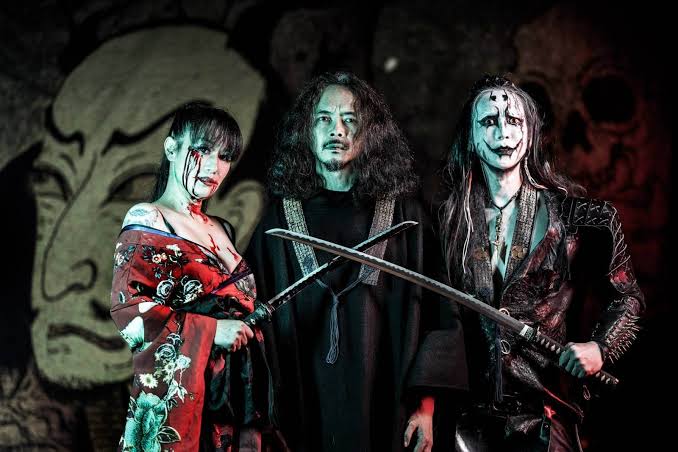 After spending so much time exploring impermanence and death while writing this album, did the experience change the way you look at life in any way?
Mirai: Unfortunately not. The cruel fact that I have to die some day will not change no matter what I do. I want to find my peace but there is no way.
At first listen, Sigh’s music can sound chaotic, but the more you listen, the more carefully structured it reveals itself to be. How important is that balance between confusion and control when you’re composing?
Mirai: Of course it has to be controled chaos. You know making chaos is very easy but I don’t see any point in doing ita s Sigh. That’s why I rely on my ears. I need to find out the best balance by
repeatedly listening to the songs.
Do you still consider Sigh a black metal band, or has black metal simply become one of the many colors on your musical palette?
Mirai: If I have to categorize Sigh’s music, I’ll say black metal. Black metal is a genre that embraces almost everything. You can do anything in it. Both Blasphemy and Alcest can be called a black
metal band while their music is poles apart. In that sense, calling our music black metal is at least better than calling it death metal or thrash metal.